 Automated Content Aggregation
 Streamlined Lead Generation
 Time-saving in Manual Data Collection
 Customized Data Feeds for Various Needs
 Rapid Data Processing and Integration
 Significant Cost Reduction

Efficiently handles large-scale crawling tasks.


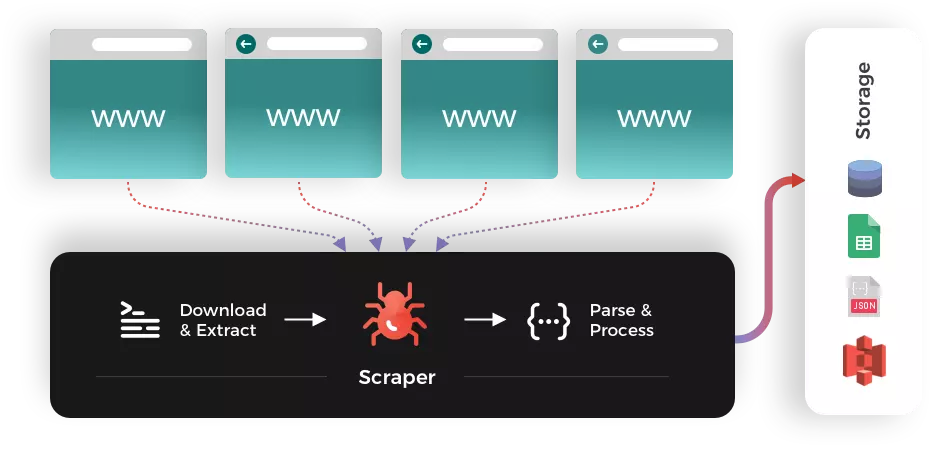
VOCSO is a web scraping services company in India building custom crawlers and managed data feeds for businesses that need clean, structured web data: prices, listings, directories and research datasets. Every source gets a compliance review first. Projects start at $10k on a fixed quote or monthly feed. Proof: our scraping pipeline keeps Colleges18 current across 12,000+ colleges.
 Reviewed by Deepak Chauhan, Founder & CEOLast updated


Custom data extraction and scraping pipelines from a team building software since 2009

Tailor-made data scraper development for extracting data from various online sources, with a focus on precision and relevance to your business needs.
Scraping JavaScript-heavy and interactive sites with Playwright, Puppeteer or Selenium, including infinite scroll, filters and AJAX-loaded content.
Cloud-hosted scrapers you control through an API or dashboard, built and hosted by us for repeatable, on-demand data collection.
Code reliable APIs to seamlessly interface with backend and front-end applications, allowing them to communicate and share data efficiently.

We create a unique backend platform to meet your highly personalized project requirements, offering flexibility and scalability for diverse front-end applications.

Monitoring, alerts and scraper fixes when source websites change, so scheduled data keeps arriving.
 Extract data from dynamic web sites
Extracting data from web pages with dynamic loading, like those using JavaScript and AJAX, challenges us. We need special tools to render these pages correctly. These tools help us access the data created by client-side scripts.

Extracts data from websites with dynamic content loading.
Ensures proper page rendering through JavaScript execution.
Utilizes headless browsers to simulate realistic page interactions.
Handles AJAX requests and waits for the dynamic content to load.
 Export data in CSV, XLSX and JSON formats
We offer data export in CSV, XLSX, and JSON formats for broad compatibility. These formats integrate seamlessly with spreadsheets, databases, and web applications. This enhances the practical use of extracted data.
These formats support a range of software, from text editors to databases and apps.
CSV and XLSX optimize data analysis in tools like Excel or Google Sheets.
JSON's lightweight format enables efficient data exchange between systems and web apps
These widely recognized formats simplify data sharing, ensuring clarity and accessibility.
 Automate data extraction in the cloud
We leverage cloud computing resources to automate data extraction, streamlining the process and enabling scalability. We eliminate the need for local infrastructure, allowing for automated scheduling, processing, and storage of extracted data.
Scale resources as needed to manage fluctuating data extraction volumes.
Eliminate local server and hardware maintenance, reducing costs.
Automate data collection at intervals or in real-time for fresh data.
Store extracted data in a centralized cloud repository, accessible anywhere.
 Integrate data with any system
We integrate extracted data with various systems to ensure seamless data flow and enable unified, data driven decision making. This integration utilizes APIs, webhooks, or direct database connections for smooth data transfer and interoperability.
Combine data from multiple sources into a single, comprehensive view.
Enable cross system analysis to uncover valuable insights.
Trigger actions and automate processes based on integrated data.
Provide a complete understanding for more informed business decisions.
We choose tools per source rather than forcing one stack onto every site: lightweight HTTP parsers for static pages, headless browsers for JavaScript-heavy sites, OCR for scanned documents and LLMs for unstructured text. The output is always structured, validated and ready to load into your workflow.
Efficiently handles large-scale crawling tasks.

Parses HTML and XML for precise data extraction.

Analyzes and refines scraped data for actionable insights.
Automates browser actions for dynamic content scraping.

Considered only for sources where automated access is authorised, such as client-owned or partner sites.

Enables fast, server-side HTML parsing.

Provides a robust foundation for scalable scraping solutions.
Simplifies browser automation for advanced scraping needs.

Proxy infrastructure for reliable, geo-specific collection at polite request rates.

Seamlessly controls headless browsers.

Extracts data from images and PDFs.

Enhances data processing and extraction from natural language content.

Collects publicly listed business and market data for prospecting, within data-protection rules.
Acts as an automated data aggregator for collecting and organizing information from sources.

Extracts e-commerce product details and pricing information from online stores.

Automates the extraction of business listings and contact details from online directories.

Gathers real estate property listings, prices, and market trends for investment insights.

Extracts visual content, such as images, videos, and graphics, from websites.

Collects public reviews and comments, without personal identifiers, to analyse sentiment and product feedback.
For businesses that need data consistently without the operational work, our Web Scraping as a Service (WSaaS) is a fully managed option. It suits teams that do not want to maintain, host or update scrapers themselves.
With WSaaS, we own the whole data extraction lifecycle: building and maintaining scrapers, managing proxies and hosting, monitoring data quality and reviewing compliance for each source. You receive structured data at agreed intervals, in the format you choose, without managing the underlying infrastructure.





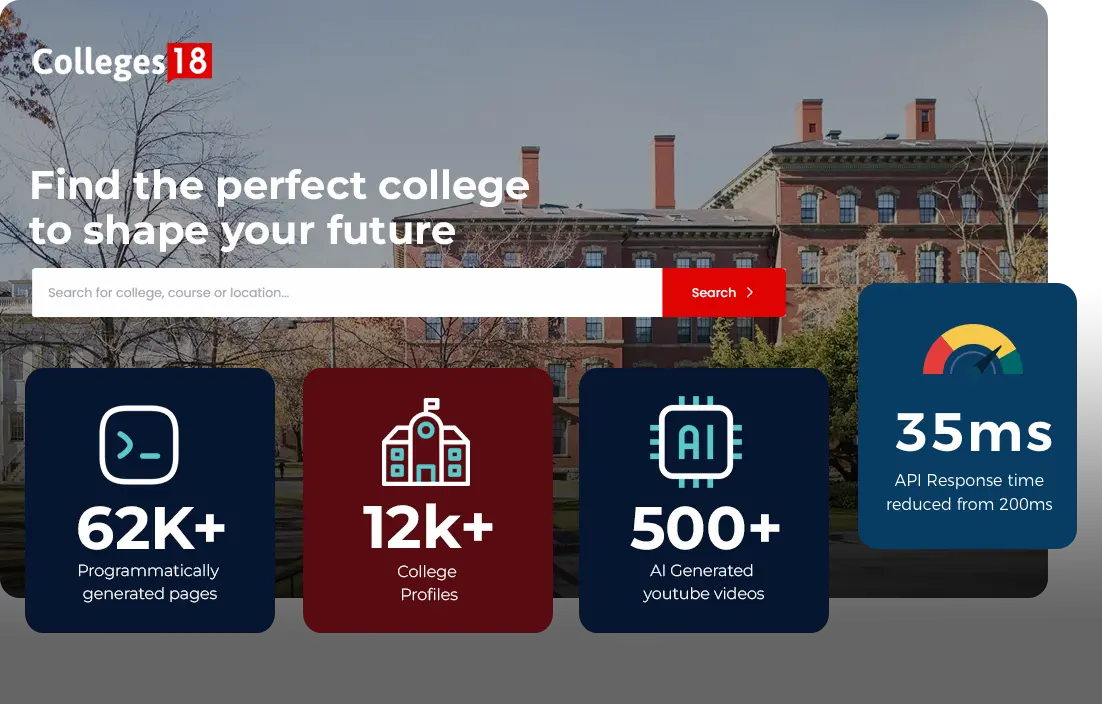

For Colleges18, a college discovery platform in India, we built a data scraping and processing pipeline that gathers college information from multiple sources, validates it and keeps 12,000+ college listings current in a Strapi and PostgreSQL back end. Next.js turns that data into more than 50 programmatic page templates.
In the first three months after launch the site earned 25.3K organic clicks and 4.85M search impressions, and it generated over 500 leads within its first month.

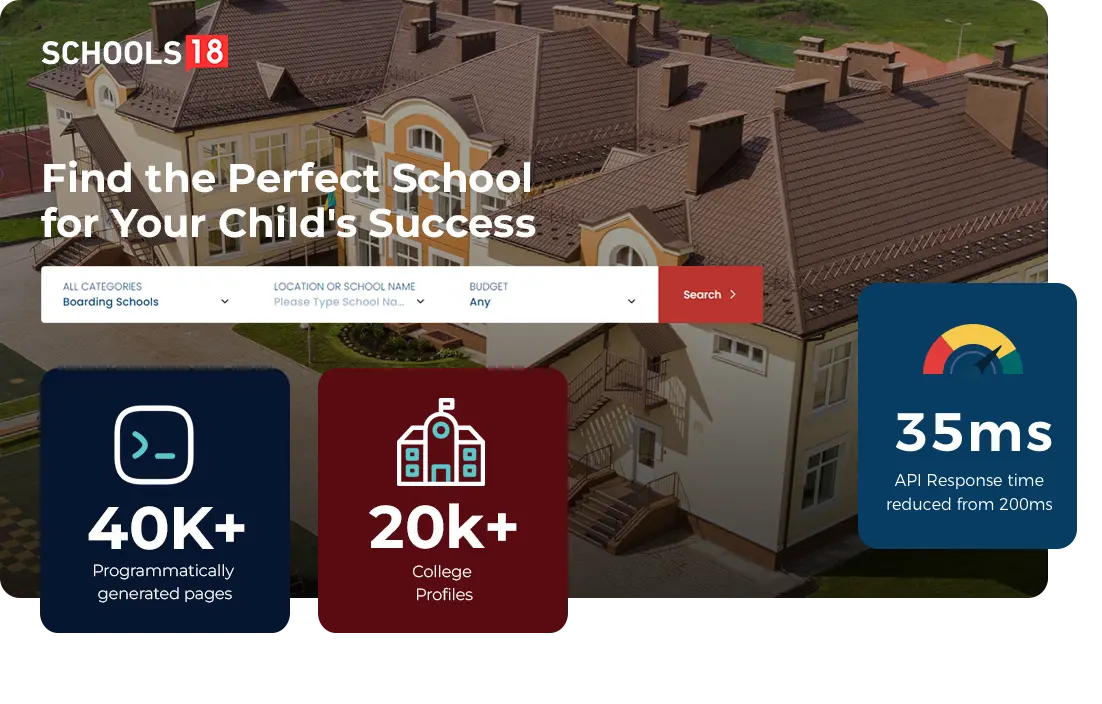

Schools18 is a school search and admissions portal covering 19,000 schools across India. We structured the school data so parents can filter by board, co-ed status, day or boarding, class range and annual fee, with results ordered by distance from the searcher, on a Node.js, Strapi and Next.js stack.

"Vocso team has really creative folks and is very co-operative to implement client project expectations. MicroSave Consulting had great experience working with Anju and Prem."

"Working with Deepak and his team at Vocso is always a pleasure. They employ talented staff and deliver professional quality work every time."


"We love how our website turned out! Thank you so much VOCSO Digital Agency for all your hard work and dedication. It was such a pleasure working with the team!"

"It was an amazing experience working with the VOCSO team. They were all so creative, innovative, and helpful! The finished product is great as well - I couldn't have done it without them"

"I want to take a min and talk about Deepak and Vocso team.We have outsourced web projects to many offshore companies but found Deepak understands the web content management and culture of US based firm and delivered the project with in time/budget . Also in terms of quality of product exceeds then anything else on which we work on offshore association I would recommend them for any web projects."

"Hi would like to appreciate & thanks Deepak & Manoj for the assistance any one thats look in to get web design They are very efficient people who can convert a little opportunity to fruitful association."


Understand your requirements and agree on commercials.
Architecture, tools and data schema chosen per source.

Crawlers, parsers and data processors built and integrated.

Data accuracy and reliability checked before go-live.

Scrapers run on schedule with monitoring and alerts.
Tell us which data you need and where it lives
Schedule a callWe pick the lightest tool that handles a source reliably. Scrapy and Requests with LXML or Beautiful Soup cover static HTML at high speed. Playwright, Puppeteer or Selenium render JavaScript-heavy sites in a headless browser. Pandas cleans and reshapes the output before delivery. Our Selenium vs Puppeteer vs Playwright comparison explains when each browser tool fits.
Python Scrapy: Ideal for creating high-speed crawling projects, offering both flexibility and power in data extraction.
Beautiful Soup: A must-have for intricate HTML parsing, making it easier to scrape data from web pages.
Selenium: Perfect for interacting with JavaScript-heavy websites, enabling dynamic content scraping with precision.
Puppeteer: Offers robust capabilities for automating browser tasks, crucial for scraping modern web applications.
Pandas: Transform and analyze your scraped data effectively, an indispensable tool for data processing and manipulation.
Requests: Simplify HTTP requests for web scraping, providing a more straightforward approach to data retrieval.
LXML: Fast and highly efficient library for processing XML and HTML, essential for parsing complex data structures.
Node.js libraries: Explore Node.js ecosystems like Cheerio or Axios for server-side scraping solutions.

Scraping publicly available data is lawful in many situations, but legality depends on what you collect, how you collect it and how you use it. We are not a law firm, so for sensitive projects we recommend a review by your own legal counsel. Our compliance review covers each source before any code is written:
robots.txt: we read it for every source and respect disallowed paths and crawl delays unless the site owner has authorised otherwise.
Terms of service: we check whether the terms prohibit automated access, and recommend an official API, data licence or written permission where they do.
Login walls and access controls: we do not scrape content behind logins or paywalls without the account owner's authorisation.
Personal data: if a source contains personal information, we assess it against laws such as the EU GDPR and India's Digital Personal Data Protection Act, 2023, collect only what is necessary, and prefer anonymised or business-only fields.
Copyright and database rights: we extract facts and data points, not copyrighted content for republication.
Server load: we throttle requests and schedule heavy crawls off-peak so we never degrade the source site.
Most scraping failures come from rate limits, IP blocks, JavaScript rendering and layout changes, not from parsing. We design for reliability first and stay within what each source permits:
Polite request rates: throttled, randomised request timing and off-peak scheduling avoid tripping rate limits and keep load low on the source.
Reliable infrastructure: managed proxy pools with geo-targeting where location-specific data is needed, and retries with back-off for transient errors.
Dynamic content: headless browsers (Playwright, Puppeteer, Selenium) fully render JavaScript and AJAX content before extraction.
CAPTCHAs and logins: a CAPTCHA or login wall is a signal that the owner restricts automated access. We pursue an official API, data licence or permission rather than defeating it, and use automation there only with the owner's authorisation.
Block and change detection: monitoring flags empty responses, block pages and layout changes, so a scraper is fixed before your data goes stale.
Data quality checks: every run is validated for completeness, field formats and duplicates before delivery.
Raw scraped data is rarely usable as-is. Every project runs through the same staged pipeline, so data is checked before it reaches your systems. Our guide to scalable scraping pipelines with Python and Scrapy covers the engineering in more depth.
Collection of Raw, Unstructured Data: Utilizing sophisticated scraping tools to efficiently collect relevant and high-quality unstructured data.
Pre-validation: Applying early-stage checks and automated scripts to eliminate irrelevant or incorrect data and correct common discrepancies.
Data Uploading to a Temporary Database: Safely transferring collected data to a temporary database, maintaining data integrity during the process.
Data Structuring and Uploading to the Main Database: Converting unstructured data into a structured format for analysis and transferring it to the main database for effective data management.
Validation, Review, and Manual Fixes: Performing extensive validation and manual reviews to ensure data accuracy and rectify any anomalies.
Deployment to the Working Data Environment: Seamlessly integrating processed data into the operational environment, ensuring its accessibility and utility for decision-making.
Choose delivery based on how the data will be used. We support all of these, and many projects combine two (for example a daily CSV for analysts plus a database feed for an application):
APIs for Data Access: Consider APIs for a seamless, programmable approach to access your scraped data, enabling efficient integration with existing systems in real-time.
Leverage Webhooks: Utilize webhooks for instant data delivery to specific endpoints, perfectly suited for applications that demand immediate data updates or alerts.
Opt for Cloud Storage: Embrace cloud storage solutions like AWS S3 or Google Cloud for scalable, secure hosting, ideal for managing large data volumes with universal accessibility.
Direct Database Insertion: Directly insert scraped data into SQL or NoSQL databases, a recommended approach for applications needing frequent data interactions and analyses.
File Downloads (CSV, JSON, XML): Export data in formats like CSV, JSON, or XML for easy offline analysis, particularly useful when data sharing or standard tool analysis is required.
Data Streams Utilization: Implement data streaming through platforms like Apache Kafka for real-time processing and analytics, best for scenarios needing on-the-fly data handling.
Custom Solutions: For unique requirements, consider developing custom solutions, ranging from tailored APIs to specialized data delivery systems, ensuring a perfect fit for your specific needs
Cost depends on the number of sources, how hard each one is to scrape (static HTML versus JavaScript-heavy or frequently changing sites), data volume, refresh frequency, and the cleaning and delivery work around it. We price in three ways:
One-time build: a scraper or dataset delivered once, on a fixed quote per defined set of sources.
Managed data feed: a setup fee per source plus a monthly fee for hosting, monitoring, maintenance and scheduled delivery.
Dedicated developers: monthly billing when you have an ongoing pipeline roadmap.
Our minimum engagement is $10,000, and larger data platforms that combine scraping with APIs, applications or AI typically run $30,000 to $150,000. Share your source list through our free quote form and we will reply with a compliance view and a fixed estimate.
You delivered exactly what you said you would in exactly the budget and in exactly the timeline.






 Transparency on every decision Talented Team of AI Engineers Smooth Collaboration & Reporting Efficient & Adaptive Workflow Strict Privacy Assurance with NDA 12 Months Free Post-Launch Support On-time Delivery, No Surprises ISO 27001 Certified Engineering
Web scraping services cover everything needed to turn websites into reliable, structured data: source analysis and compliance review, scraper development, data cleaning and validation, scheduling, hosting and delivery. At VOCSO that means crawlers for static and JavaScript-heavy sites built with Scrapy, Playwright, Puppeteer or Selenium, cleaning with Pandas, and delivery as CSV, Excel or JSON files, database inserts, webhooks or an API. We also monitor scrapers and fix them when source sites change. You can buy a one-time dataset, a managed recurring feed, or dedicated developers who extend your own scraping platform.
Scraping publicly available data is lawful in many cases, but it depends on what you collect, how and why. Before building, we review each source's robots.txt and terms of service, check for an official API or data licence, and assess any personal data against laws such as the EU GDPR and India's Digital Personal Data Protection Act, 2023. We do not scrape behind logins or paywalls without authorisation, we extract facts rather than copyrighted content for republication, and we throttle requests to avoid burdening sites. We are not lawyers, so we recommend your own legal review for sensitive projects.
Our minimum engagement is $10,000, and larger data platforms that combine scraping with APIs, applications or AI typically run $30,000 to $150,000. Price depends on the number of sources, how difficult each is to scrape, data volume, refresh frequency and the cleaning and delivery work required. One-time datasets are quoted as a fixed price for a defined set of sources. Managed feeds are priced as a setup fee per source plus a monthly fee for hosting, monitoring and maintenance. Send us your source list and required fields and we will reply with a fixed estimate.
An Indian web scraping company gives you an experienced engineering team at offshore rates, and VOCSO adds the process controls larger clients expect. We are headquartered in Faridabad, near Delhi, have been building software since 2009 and have delivered 600+ projects. Our information security processes are certified to ISO/IEC 27001 and our quality management to ISO 9001:2015, and every engagement starts with an NDA. We work with clients in India, the US, the UK, Canada and the UAE, with call times arranged to overlap their working day and weekly progress reporting.
We render dynamic sites in headless browsers such as Playwright, Puppeteer or Selenium, and keep scrapers reliable with polite, throttled request rates, off-peak scheduling, managed proxy pools and retries with back-off. Monitoring detects block pages, empty responses and layout changes, so we fix problems before your data goes stale. A CAPTCHA or login wall usually means the site owner restricts automated access, so in those cases we look for an official API, a data licence or permission rather than trying to defeat it. Our Playwright vs Puppeteer vs Selenium comparison explains the tooling.
We deliver data in whatever format your team or system uses: CSV, Excel (XLSX), JSON or XML files; direct inserts into PostgreSQL, MySQL or MongoDB; files in AWS S3 or Google Cloud Storage; webhooks; a REST API; or a Kafka stream for real-time processing. Schedules can be hourly, daily, weekly, monthly or on demand. Many projects combine two outputs, such as a daily spreadsheet for analysts and a database feed for an application. Every delivery is validated for completeness, field formats and duplicates first, and we agree the schema with you before the first run.
We detect it and fix the scraper, usually before you notice. Websites change their HTML, URLs and anti-bot settings regularly, so every scraper we run includes monitoring that checks record counts, empty fields and block pages after each run and alerts our team when something looks wrong. On a managed feed, repairs are included in the monthly fee. On a one-time build, we hand over documented code and can fix changes on a time-and-materials basis. Designing parsers around stable data attributes rather than fragile page positions keeps most changes small.
Both. A one-off build suits a single dataset or a scraper your own team will run; we hand over documented code and deployment instructions. Managed Web Scraping as a Service suits recurring needs: we host the scrapers, manage proxies and scheduling, monitor quality, review compliance and deliver data at agreed intervals, so you never touch the infrastructure. Managed pipelines can also feed larger systems we build, such as the data behind Colleges18 or Schools18, custom APIs, dashboards or AI applications that let teams query scraped data in plain language.

Certified, partnered and independently rated