The engineering team behind production AI systems, from document Q&A to conversational BI


We design, build and implement retrieval-augmented generation (RAG) systems that let enterprise teams get answers from their documents, databases and business apps, with citations and permission checks. A fixed-price proof of concept costs $12K–$20K over about six weeks; a production RAG assistant typically runs $20K–$60K in 8–12 weeks. ISO 27001-certified, building software since 2009.
 Reviewed by Deepak Chauhan, Founder & CEOLast updated


The engineering team behind production AI systems, from document Q&A to conversational BI

A short discovery maps your use case, data sources, access rules and accuracy target, then fixes the retrieval design, model and hosting. You get a costed plan before any build.
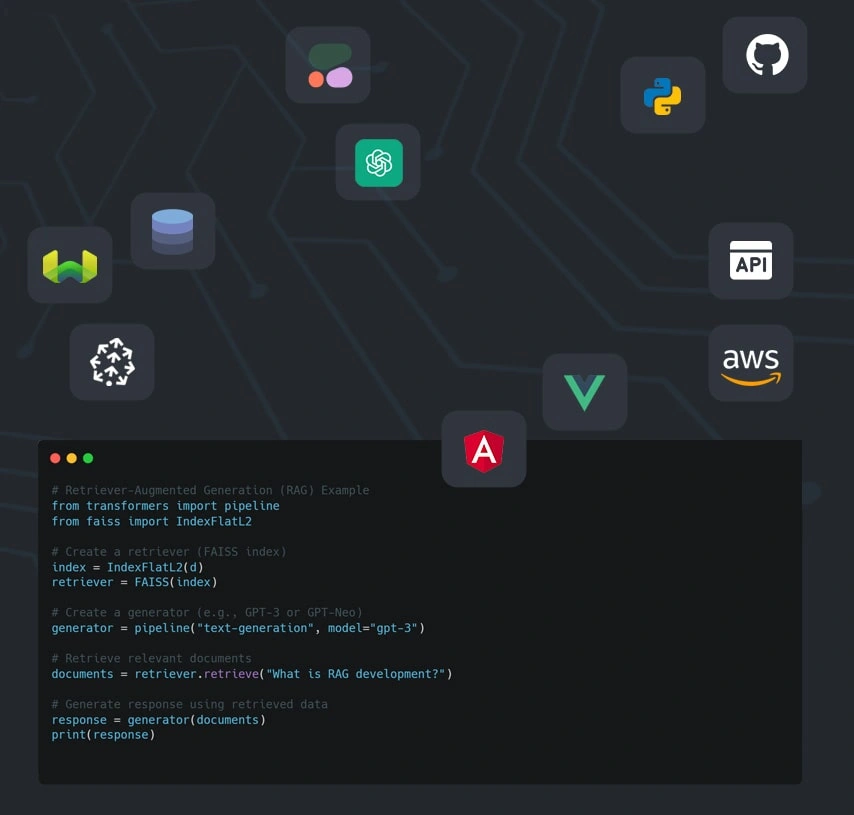
Ingestion, retrieval and generation built as separate, testable services in Python, so you can swap a model, embedding or vector store without a rewrite.

Layout-aware parsing of PDFs, Word files, HTML and scanned pages; chunks split by headings and table rows, tagged with title, section path, date and ACLs.

pgvector when you already run Postgres, Qdrant or Weaviate for self-hosting, Pinecone for managed scale, OpenSearch or Elasticsearch when keyword search matters as much as vectors.

Vector search plus BM25 keyword search, merged and reordered by a cross-encoder reranker, so the right passage reaches the prompt even for names, codes and acronyms.

Connectors for document stores, wikis, ticketing tools, CRMs and internal APIs that sync content, owners and permissions on a schedule or through change feeds.

Questions over PostgreSQL, MySQL, SQL Server or a warehouse, answered by generating and validating SQL against a semantic layer instead of embedding rows.

We test GPT, Claude, Gemini and open models such as Llama or Mistral on your questions, then choose on accuracy, latency, cost per answer and where data may be processed.

Answers grounded only in retrieved passages, with source links, a clear "not found" response, PII redaction and defences against instructions hidden inside documents.

A golden question set scored for retrieval recall, faithfulness and citation accuracy on every change, plus request tracing, user feedback and cost dashboards in production.

Assistants for support, HR, IT and sales teams, delivered in your web app, Slack or Microsoft Teams, with handover to a person when confidence is low.
Most clients start with one high-value use case, prove it on real questions, then reuse the same retrieval layer for the next.
Policies, SOPs and project archives answered in plain language.

Answers drafted from manuals and past tickets, with sources for the agent.
Clause lookup and comparison across contracts and regulations.

Questions over reports and ledgers, answered with figures and references.

Search across clinical and research documents with strict access control.

Product questions answered from catalogues, specs and reviews.

Literature and course material search with cited answers.

Semantic search that finds the right page, not just a keyword match.
Proposal content, case studies and pricing rules on demand for sales teams.

Answers from code docs, runbooks and architecture notes.
Transcribed video and meeting recordings, searchable to the timestamp.
Ranges from our delivered AI projects. Data readiness and the number of sources and permission rules move the price most. Plan another 15–25% of the build cost per year for inference, hosting and upkeep.
One use case on a sample of your real documents, scored against your own questions, with a costed plan for production.
One assistant over defined sources with hybrid search, citations, access control and an evaluation set, deployed in your cloud.
Many sources and teams: synced connectors, permission-aware retrieval, evaluation harness, monitoring and an admin console.
 Dedicated RAG Team
A full-time pod of RAG and data engineers, typically with a tech lead, for ongoing work across several use cases.
 160 hours per engineer per month Monthly billing, no hidden costs You set priorities each sprint Dedicated account manager Code in your repositories Weekly evaluation reports
 Fixed Price
Best for a proof of concept or a production assistant with agreed sources, questions and accuracy targets.
Fixed budget and timeline Scope agreed after discovery Milestone-based payments Evaluation report at hand-over Transparent reporting Costed plan for the next phase Time & Materials
Pay for the hours worked when sources, questions or accuracy targets are still being discovered.
Flexible billing by the hour Change direction any sprint Good for tuning and extensions No long-term commitment Timesheets and progress reports Easy move to a dedicated teamNot sure which model fits your RAG project?
Schedule a call


See more in our AI project portfolio, or how this work became DataSense, our conversational BI product.





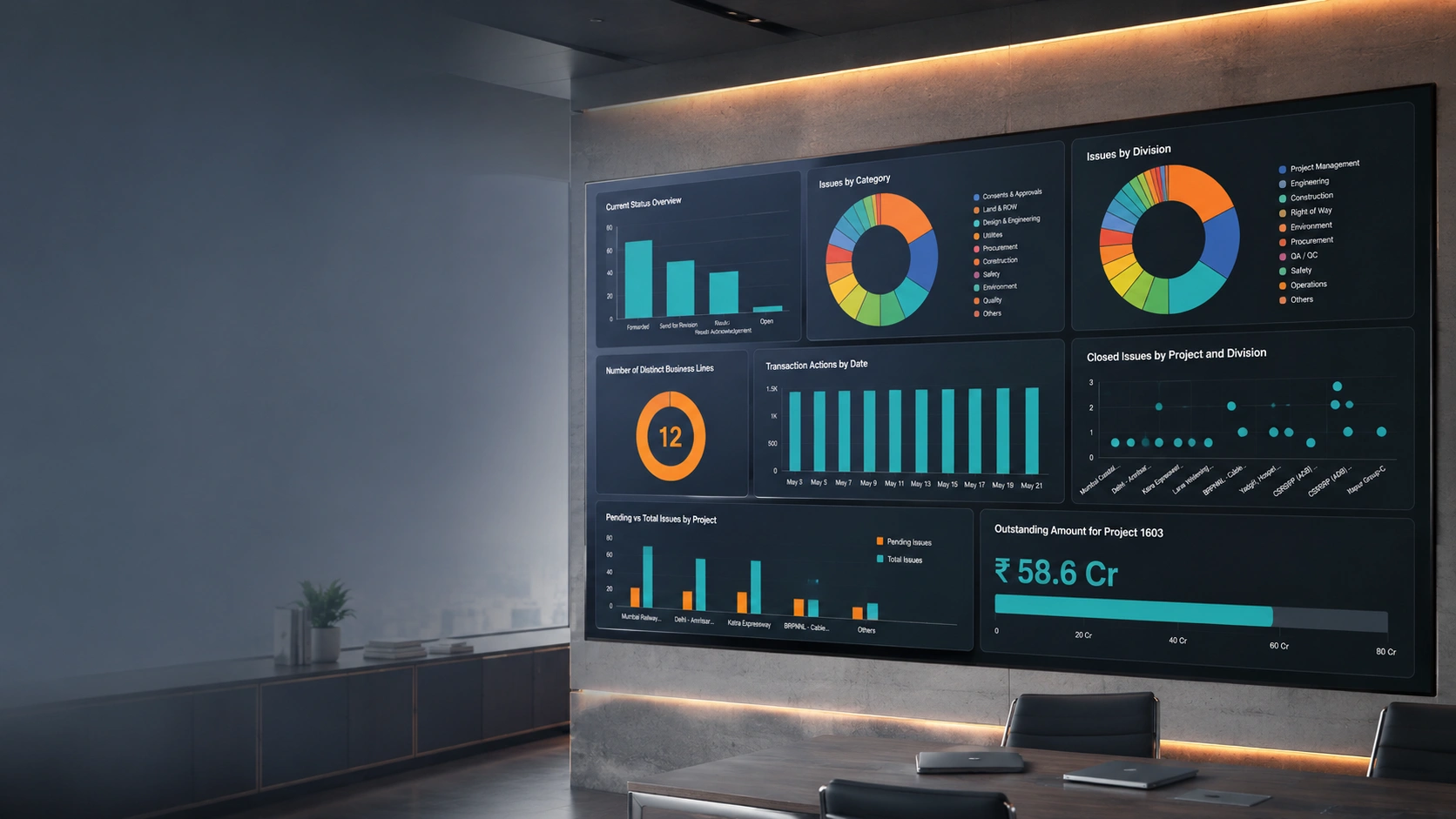
Rodic Consultants needed non-technical staff to get answers from internal financial and project databases without waiting for the tech team. We built an LLM query engine that turns plain-English questions into validated SQL, with a business-rule layer, Elasticsearch indexing and embeddings, and role-based access. In the pilot it answered 739 natural-language queries, each returned as a chart, a written insight and an Excel export.


"Vocso team has really creative folks and is very co-operative to implement client project expectations. MicroSave Consulting had great experience working with Anju and Prem."

"Working with Deepak and his team at Vocso is always a pleasure. They employ talented staff and deliver professional quality work every time."



Use case, sources, access rules and the questions that define success, agreed in a free discovery call.
A working pilot on a sample of your real content.
Connectors and pipelines for every source in scope.
Turn retrieved passages into trustworthy answers.

Ship only when the scores meet the agreed target.
Want to see how a RAG pilot would work on your data?
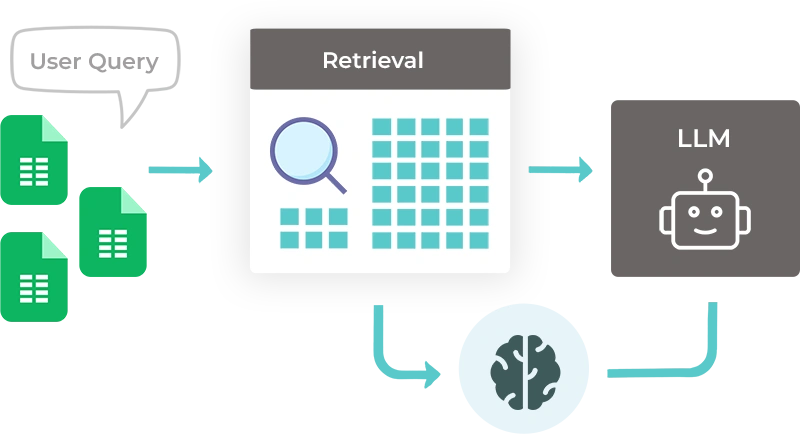
Schedule a callRetrieval-augmented generation is a pattern where an application first searches your own content for passages relevant to a question, then gives those passages to a large language model with instructions to answer only from them. The model supplies language skill; your documents supply the facts. For a longer walkthrough, read our guide to what RAG is and when to use it.
Retrieval: find the most relevant chunks in a vector and keyword index, filtered by the user's permissions.
Augmentation: place those chunks, with their sources, into the prompt.
Generation: the LLM writes an answer grounded in the supplied text and cites where each point came from.
A demo can be built in a day. A system people trust takes careful ingestion, retrieval tuning, access control and evaluation, which is where most of the engineering effort goes.
In our experience, a RAG system that holds up in production has eight parts. We cover each one in detail in our enterprise RAG architecture reference design.
Ingestion pipeline that parses and chunks by document structure.
Hybrid retrieval: vector search plus keyword (BM25) search.
Reranker that reorders candidates by true relevance.
Access control enforced at query time from source ACLs.
Cited answers with links back to the source.
Evaluation harness for retrieval and answer quality.
Freshness strategy so changed documents are re-indexed.
Tracing on every request, with user feedback.
Most production failures come from retrieval, permissions and stale data, not from the model.
The vector store holds embeddings and runs similarity search. The right choice depends on what you already run, where data must live and how much filtering you need.
| Option | Good fit when | Watch for |
|---|---|---|
| pgvector (Postgres) | You already run Postgres and want one database | Tuning needed at tens of millions of vectors |
| Qdrant | Self-hosted or on-premise with rich metadata filters | You operate and back it up |
| Weaviate | Built-in hybrid search and schema in one engine | More moving parts to run |
| Pinecone | Fully managed scale with little operations work | Data sits with a third-party service |
| OpenSearch / Elasticsearch | Keyword search matters as much as vectors | Heavier to run for small corpora |
| ChromaDB | Prototypes and local experiments | Not our choice for multi-tenant production |
We decide this during architecture, with your security team, rather than after problems appear.
These approaches solve different problems, and many production systems combine them.
| Approach | Best for | Limits |
|---|---|---|
| RAG | Answering from large or changing knowledge, with citations and permissions | Quality depends on retrieval and ingestion |
| Fine-tuning | Teaching a model a format, tone or narrow task | Poor at adding facts; must be redone as content changes |
| Long context | A few long documents per question | Cost and latency grow with every token; no access control |
If your question is "what do our documents say", start with RAG. If it is "always answer in this structure", consider LLM fine-tuning. We often fine-tune a small model for a step inside a RAG pipeline.
No RAG system we build goes live without numbers. Evaluation starts in the proof of concept and runs on every change after launch.
Golden question set: 50–200 real questions from your users, each with the passages that should be found.
Retrieval metrics: recall@k and mean reciprocal rank, so we know whether the right chunk reached the prompt.
Answer metrics: faithfulness to the retrieved text, citation accuracy and relevance, scored by an LLM judge with human spot checks.
Regression gates: a new prompt, model or chunking rule ships only if scores hold or improve.
Production signals: tracing, thumbs up or down, "not found" rates and cost per answer.
Enterprise RAG touches sensitive content, so security is designed in from the first sprint.
Permission filtering: document ACLs captured at ingestion and enforced on every query.
Hosting choice: your own cloud account, model APIs through Azure OpenAI, AWS Bedrock or Google Vertex AI, or self-hosted open models when data cannot leave your network.
Prompt-injection defence: retrieved text is treated as data, never as instructions.
PII handling: redaction before indexing or before generation, depending on the use case.
Audit trail: every question, retrieved source and answer is logged.
VOCSO works under ISO/IEC 27001 and ISO 9001:2015 certified processes and signs an NDA before discovery.
We use frameworks where they save time and write plain code where they get in the way.
LangChain and LangGraph: orchestration, tool calling and multi-step flows.
LlamaIndex: ingestion, indexing and query engines over many document types.
Haystack: pipeline-style retrieval and evaluation.
FastAPI services: the production API around the pipeline, with auth, rate limits and tracing.
Our comparison of top RAG frameworks explains when each one fits.
You delivered exactly what you said you would in exactly the budget and in exactly the timeline.





 Transparency on every decision Talented Team of AI Engineers Smooth Collaboration & Reporting Efficient & Adaptive Workflow Strict Privacy Assurance with NDA 12 Months Free Post-Launch Support On-time Delivery, No Surprises ISO 27001 Certified Engineering
RAG development services cover the design, build and operation of systems that answer questions from your own content using a large language model. The work includes connecting data sources, parsing and chunking documents, building vector and keyword indexes, tuning retrieval and reranking, enforcing access rights, writing the prompts that produce cited answers, and setting up evaluation and monitoring. At VOCSO the engagement usually starts with a fixed-price proof of concept on your real documents and ends with a deployed assistant, API or search experience inside the tools your team already uses, plus the test set that proves it works.
A RAG proof of concept typically costs $12,000–$20,000 and takes about six weeks. A production RAG assistant over a defined set of sources usually costs $20,000–$60,000 over 8–12 weeks, and an enterprise platform with many connectors, teams and permission rules runs $60,000–$150,000 or more over three to six months. The biggest cost drivers are data readiness, the number of sources and how strict the accuracy and security requirements are. Budget roughly 15–25% of the build cost per year for model usage, hosting and upkeep. Our AI development cost guide explains each band.
Most RAG implementations take 6 to 12 weeks from kickoff to a production pilot. The proof of concept takes about six weeks: one week of discovery and data audit, then ingestion, retrieval tuning and evaluation on a sample of your content. Hardening for production, which adds connectors, access control, monitoring and integration into your app or Microsoft Teams, usually takes another four to six weeks. Larger rollouts across several departments run three to six months. The main thing that slows projects down is access to data and to the people who can say what a correct answer looks like, so we plan both in week one.
Use RAG when the model needs to answer from knowledge that is large, private or changes often, and when users need citations or permission checks. Use fine-tuning when you need the model to follow a format, tone or narrow task consistently. Fine-tuning is a poor way to add facts, because the model can still invent details and must be retrained whenever content changes. Many systems combine the two, for example a RAG pipeline with a small fine-tuned model that classifies questions or formats answers. We test both on your questions during the proof of concept and recommend whichever gives better accuracy for the cost. See our LLM development services for model work beyond retrieval.
We reduce hallucinations by improving retrieval first, then constraining generation, then measuring both. Retrieval uses structure-aware chunking, hybrid vector and keyword search and a reranker, so the right passage actually reaches the model. Prompts instruct the model to answer only from supplied text, cite each source and say "not found" when the answer is missing. Every system is scored against a golden set of real questions for retrieval recall, faithfulness and citation accuracy before launch, and the same tests run on every later change. In production, tracing and user feedback show which questions fail, so we can fix the cause rather than guess.
Yes. We can deploy the full RAG stack in your own AWS, Azure or Google Cloud account, call models through enterprise endpoints such as Azure OpenAI, AWS Bedrock or Google Vertex AI, or run open models such as Llama or Mistral on your own servers when data cannot leave your network. Document permissions are captured at ingestion and enforced on every query, retrieved text is treated as data rather than instructions, and every question and answer is logged for audit. VOCSO works under ISO/IEC 27001 and ISO 9001:2015 certified processes and signs an NDA before discovery begins.
Yes. Documents are only one source. We connect RAG systems to wikis, ticketing tools, CRMs, ERPs and internal APIs, and we handle structured data differently from text. For questions over SQL databases or a warehouse, the system generates and validates SQL against a semantic layer instead of embedding rows, which keeps numbers exact. That is the approach behind our conversational BI services and the Rodic conversational BI case study, where the pilot answered 739 natural-language queries from enterprise databases. Hybrid assistants can combine document answers and live data in one chat.
VOCSO is a software and AI engineering company based in Faridabad, India, building software since 2009 with 600+ projects delivered and a 25+ person in-house engineering team. We have built production AI on enterprise data, including the Rodic conversational BI platform and our own DataSense product, so we plan for permissions, evaluation and run costs from the start. Senior engineering time in India typically costs around half of US agency rates for the same scope. We work under ISO/IEC 27001 and ISO 9001:2015, sign an NDA on day one, and engagements start at $10,000, usually with a fixed-price pilot.

Certified, partnered and independently rated




 Answers Grounded in Your Data
 Citations Users Can Check
 Current Information Without Retraining
 Permission-Aware Answers
 Lower Cost Than Fine-Tuning for Knowledge
 Model Choice Stays Open
 Measurable Quality
 One Platform, Many Use Cases